
US proposal to raise the global corporate tax rate to 28% from 21% might face resistance from countries unwilling to give up their edge and compete with America on its terms.

The group has called for a retaliatory tariff action against India, if New Delhi does not roll back the 'unilateral and discriminatory' equalisation levy or Google Tax.

They say that a stimulus package may not be necessary because, unlike last year's total lockdown, public transport, including the railways and airlines, is running and the restrictions on movement are localised and, in some cases, are partial rather than total.

The Tatas, L&T and Bharat Forge expressed interest in building pressure swing adsorption oxygen plants at hospital sites, while IOC and RIL are pitching in with both oxygen and cryogenic tankers needed for its transportation.

This will be an upfront payment for the vaccine doses that these two companies will supply to the government.

According to industry figures, the pre-Covid demand for liquid medical oxygen (LMO) before the pandemic was 700 tonnes per day across the country. Now, with the second wave, the demand has gone up more than seven times, reports Jyoti Mukul.

'Personal income tax collections have been high on account of impressive advance tax mop-up.'
'Our automakers export 50 per cent of what they manufacture and once the policy comes into play, which is in the next 2-3 years, we would become a Rs 10 trillion industry.'

Other decisions piled up include rationalisation of GST rate slabs, correction of inverted duty on certain items and inclusion of petroleum products.

'We completed Rs 17 trillion worth of projects in the first term and currently Rs 9 trillion worth of contracts are under construction.'

Zero-coupon bonds don't give out interest but are issued at a deep discount to the face value, making it difficult to ascertain the net present value.

Providing comfort to the government on the revenue front amid fiscal stress, direct tax collection is moving closer to the revised Budget target for 2021-21 and may get a further thrust from the last instalment of the advance tax payment, the deadline for which ended on Monday. The contraction in net direct tax collection narrowed to 5 per cent year-on-year as on March 15 compared to a 9 per cent decline seen in January. In absolute terms, net collection stood at Rs 8.2 trillion against Rs 8.67 trillion in the same period last year, according to the provisional numbers shared by a government official.
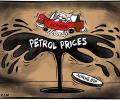
Many states are open to the idea of petrol and diesel being brought under the goods and services tax (GST) regime - contrary to the perception that they are averse to it - but they want a concrete proposal, including a compensation mechanism, from the Centre. West Bengal Finance Minister Amit Mitra says while the issue can be discussed, the Centre may not be keen to bring the change because it earns "much more" from taxes on petrol and diesel. "(The peak rate of) GST is 28 per cent. Under the regime, the Centre would only get 14 per cent. "So, definitely, the Union government does not want GST on fuel. It is all lies. Currently, they are in a very cozy place," Mitra said.
During a series of hectic talks between Cairn Energy and the Indian government over the $1.2-billion arbitration award in favour of the former last week, a slew of options was proposed by the two sides, including computation of capital gains and participation in the Vivad se Vishwas (VsV) dispute resolution scheme. The government is likely to go ahead and appeal against the arbitration award by a Permanent Court of Arbitration at The Hague before March 21, indicated finance ministry officials. Cairn Energy Plc on Sunday said it was hopeful that an acceptable solution to its tax dispute with the Indian government could be found to avoid prolonging and exacerbating the 'negative issue' for all parties.

A senior company executive said the company waited for seven years for the verdict and its shareholders needed to know when it would be concluded.

The number of centrally sponsored schemes have increased to 35 in FY22 from 30 in FY21 and central sector schemes have increased to 704 from 685 in the previous year, reports Dilasha Seth.

The Budget proposed abolishing the under-performing, authority of advance ruling, to replace it with a two-member board of advance ruling.

'It is just an excuse to say that the Centre has run out of money.' 'Pruning these schemes would mean hard time for the people of India.'
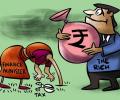
While the tax-to-GDP ratio of 9.88 per cent has been assumed for FY21, the same as last year, when it touched a decadal low, for FY22 a ratio of 10.7 per cent has been assumed, an average of the last five years.

'However, this time it looks like that is not working.'
 © 2026 Rediff.com - Investor Information - Advertise with us - Disclaimer - Privacy Policy - Sitemap - Feedback - About us - Terms of use - Grievances